The Impact of Artificial Intelligence on Paralegal Work - Challenges and Opportunities
Introduction
Artificial Intelligence is rapidly transforming the legal profession, raising pressing questions about the future role of paralegals. Recent advances — especially in generative AI tools like ChatGPT, Claude, and Gemini — have led to predictions ranging from enhanced productivity to potential job displacement. In the face of these changes, paralegals are encouraged to view AI not as a replacement but as a tool that can augment their work (Susskind & Susskind, 2022). Many experts argue that while AI will automate routine tasks, it will also free paralegals to focus on higher-value activities (Thomson Reuters, 2023).
Two years ago, practitioners debating AI’s role in the legal profession were asking whether the technology was ready. That question has an answer now. Sixty-nine percent of legal professionals report using AI in their daily work — a figure that more than doubled year-over-year, according to the 8am.com 2026 State of AI in the Legal Industry Report — and the ABA’s Year 2 Report on the Impact of AI on the Practice of Law documents the technology’s migration from experimentation to core infrastructure (8am.com, 2026; ABA, 2025). The ABA’s 2024 Legal Technology Survey found that 30% of attorneys now use AI-based tools, nearly triple the 11% reported just one year earlier (ABA, 2024c). The International Legal Technology Association’s 2024 survey of 536 firms found that 37% were using generative AI for business tasks, with adoption ranging from 20% among small firms to 74% among firms with 700 or more lawyers (ILTA, 2024). The question has shifted. What practitioners are working through now is not whether AI belongs in legal workflows but how profoundly it will restructure them, on what timeline, and at whose expense.
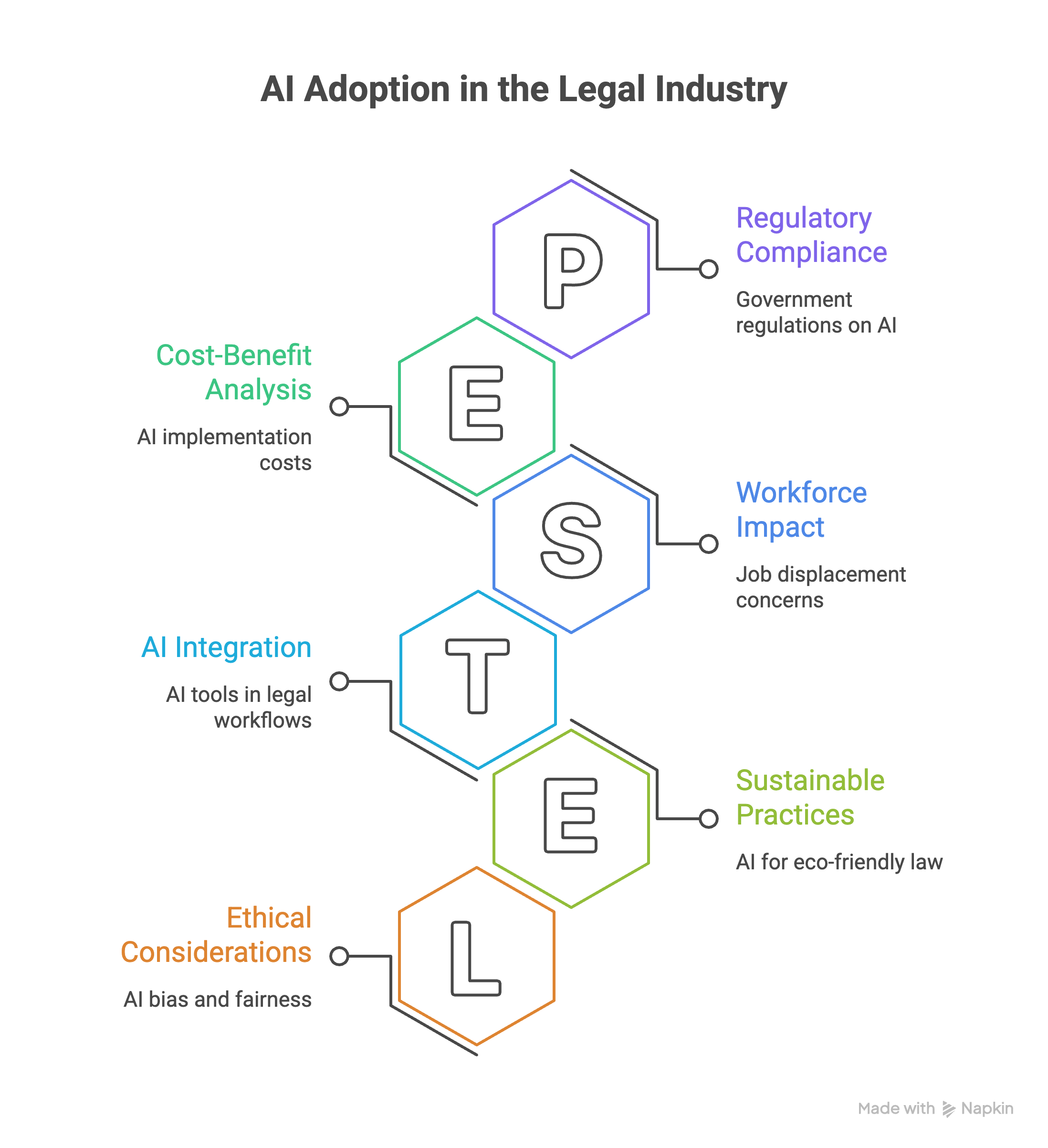
Paralegals sit at the center of that question. They execute a substantial share of the document-intensive, research-intensive work that AI performs most aggressively; they lack the institutional protection of bar membership; and they carry the verification responsibility that AI’s persistent error rates make indispensable. The current evidence supports neither the catastrophist reading — that AI will systematically displace paralegal roles — nor the complacent one. The profession is pivoting. Paralegals who understand the actual research, rather than the headlines derived from it, will be positioned to shape that pivot rather than absorb it.
This article examines the current and projected impact of AI on paralegal work in the United States, drawing on peer-reviewed research, government labor data, and major industry surveys through mid-2026. Key themes include task automation, the employment picture, evolving professional responsibilities, the emergence of agentic AI systems, ethical obligations, and concrete strategies for practitioners navigating the transition.
AI Integration in Paralegal Work
AI technologies are already being integrated into many paralegal tasks across the legal industry. Law firms are adopting AI-powered tools for legal research, e-discovery, document review, contract analysis, and more. Casetext launched CoCounsel in March 2023 as the first AI legal assistant built on GPT-4. Thomson Reuters acquired Casetext for $650 million in August 2023 and expanded CoCounsel into a professional-grade AI platform spanning legal, tax, compliance, and audit workflows; by February 2026, the platform had reached one million users across 107 countries and territories (Thomson Reuters, 2026). LexisNexis renamed its Lexis+ AI platform to Lexis+ with Protégé on February 24, 2026, embedding a multi-agent architecture that deploys an orchestrator, a legal research agent, a web search agent, and a document agent in parallel on complex queries (GC AI, 2026).
That architectural shift — from AI assistants that respond to prompts toward AI agents that autonomously plan, execute, and evaluate multi-step tasks — is the most consequential technical development of 2026 for paralegal practice. At Legalweek in March, a demonstrator showed an agent taking a single litigation hold notice and autonomously identifying custodians, mapping data sources, drafting preservation letters, and scheduling collection in under four minutes (PlatinumIDS, 2026). The Thomson Reuters Institute’s 2026 AI in Professional Services Report found that 43% of law firms and legal departments had deployed an enterprise-wide generative AI tool by early 2026, up from 14% just two years prior (Thomson Reuters Institute, 2026). Among large firms and legal departments, those percentages are approaching 100%.
Generative AI tools can quickly draft emails, contracts, and legal memos in a fraction of the time. A comparative analysis of legal workflow efficiency found that AI-assisted paralegals completed routine document review tasks significantly faster than those using traditional methods, while maintaining comparable accuracy rates, with meaningful cost reductions for standard legal document preparation (Ghurbhurun, 2024). Paralegals today might encounter AI in tools that assist with legal research — an AI system can scan thousands of case files for relevant precedents within seconds, a task that used to consume many hours (Knutsen, 2024). Document review is another area being transformed: AI can automatically flag relevant documents or clauses, helping paralegals during discovery.
Legal education is adapting rapidly to prepare new paralegals for an AI-integrated workplace. A 2025 survey by Artificial Lawyer found that a strong majority (74%) of legal educators support curriculum reform to address AI, and the ABA found that 55% of law schools now offer classes dedicated to AI (ABA, 2024a; Artificial Lawyer, 2025). Case Western Reserve University School of Law became the first law school to require an AI certification for all first-year law students, signaling a broader shift toward mandatory AI competency in legal training (CWRU, 2025). Yet despite growing institutional recognition, a significant training gap persists at the firm level: the 8am.com 2026 report found that 54% of firms have implemented no formal AI training program, and where training does exist, paralegals are identified as the top priority group — cited by 39% of respondents (8am.com, 2026). Robert Half’s 2026 legal hiring data documents over 24,300 paralegal job postings in 2025 that increasingly specify AI proficiency as either required or highly desired (Robert Half, 2026). According to Wolters Kluwer’s Future Ready Lawyer Survey (2024), a majority of law firms report that legal professionals regularly use AI tools for tasks like document drafting, legal research, and client communication (Wolters Kluwer, 2024).
The Potential for Task Automation
AI’s growing capabilities have led to analyses of what proportion of paralegal work can be automated. Studies diverge in their estimates, but all suggest a significant impact. According to the 2024 Legal Trends Report by Clio, as much as 69% of the hours billed by paralegals could be automated using current AI technology (Clio, 2024). This startling statistic implies that over two-thirds of tasks like document preparation, form completion, and basic research might eventually be done by AI. Similarly, Goldman Sachs researchers estimated that generative AI could automate approximately 44% of legal tasks in the U.S., including document analysis and administrative duties that are core parts of a paralegal’s job (Briggs & Kodnani, 2023).
Global job impact studies reinforce these findings on a broader scale. A 2023 Goldman Sachs report warned that AI could put 300 million full-time jobs at risk worldwide, with white-collar roles (including legal support roles) being especially susceptible (Briggs & Kodnani, 2023). Legal support staff and administrative assistants were identified among the occupations at highest risk of automation in that analysis.
The WEF’s 2025 Future of Jobs Report introduces a distinction the legal AI literature often collapses. It identifies legal secretaries and administrative assistants among the fastest-declining occupations globally, driven by AI and automation; it does not place paralegals in that category (WEF, 2025). Administrative and secretarial functions involve the structured, repeatable inputs that current AI handles reliably. Paralegal work involves the jurisdictional precision, evidentiary judgment, and procedural contextual knowledge that produce the 47% legal sector success rate documented in the April 2026 MIT task completion study — the lowest of any sector tested (Axios, 2026). That distinction matters for how practitioners think about near-term exposure.
It is important to note that the range of estimates reflects different methodologies — some focus on tasks, while others focus on job roles. McKinsey’s global AI survey suggests adoption in legal services will likely continue to advance but may be limited by organizational readiness and trust, not just technical feasibility (McKinsey & Company, 2022). In other words, even if AI can do something in theory, firms will adopt it gradually in practice. Still, the consensus is that a substantial share of routine paralegal work is technically automatable with current or near-future AI.
Impact on Employment and Job Outlook
One of the central questions is whether AI will reduce the demand for human paralegals or simply change the nature of their work. Some commentators express concerns about the future of the profession given AI’s advancing capabilities. Knutsen (2024) argues that AI could significantly reduce the need for paralegals as AI becomes cheaper, faster, and more accurate at core paralegal tasks. While this represents a more pessimistic viewpoint, it captures the legitimate concerns that many paralegals have about the evolving profession.
The employment picture for the legal sector as a whole is more favorable than the automation commentary suggests — though that aggregate conceals meaningful variation by role and experience level. U.S. legal employment reached a record 1,243,500 jobs in June 2026, the third consecutive monthly all-time high, according to preliminary Bureau of Labor Statistics data (JD Journal, 2026). Law firm revenues have tracked accordingly: the Thomson Reuters Institute’s 2026 Report on the State of the U.S. Legal Market documented a surge in legal demand driven by trade conflicts, regulatory change, and geopolitical tension, with firm spending on salaries increasing 8.2% over 2024 levels (Roth Staffing, 2026). Paralegal unemployment specifically stood at 3.6% in Q1 2026 — well below the 4.3% national average (Robert Half, 2026).
Against that favorable aggregate, the U.S. Bureau of Labor Statistics projects near-zero growth (approximately 1%) in paralegal and legal assistant employment over the decade 2024–2034, reflecting a workforce of approximately 376,200 paralegals nationally. The BLS anticipates approximately 39,300 job openings each year due to turnover and retirement, suggesting that opportunities will still exist (BLS, 2024). Industry surveys, however, reveal a more divided outlook: the 8am.com 2026 report found that 39% of legal professionals expect AI to reduce paralegal headcount, while 22% expect it to enable expansion — a split that underscores the deep uncertainty about AI’s net employment effect (8am.com, 2026).
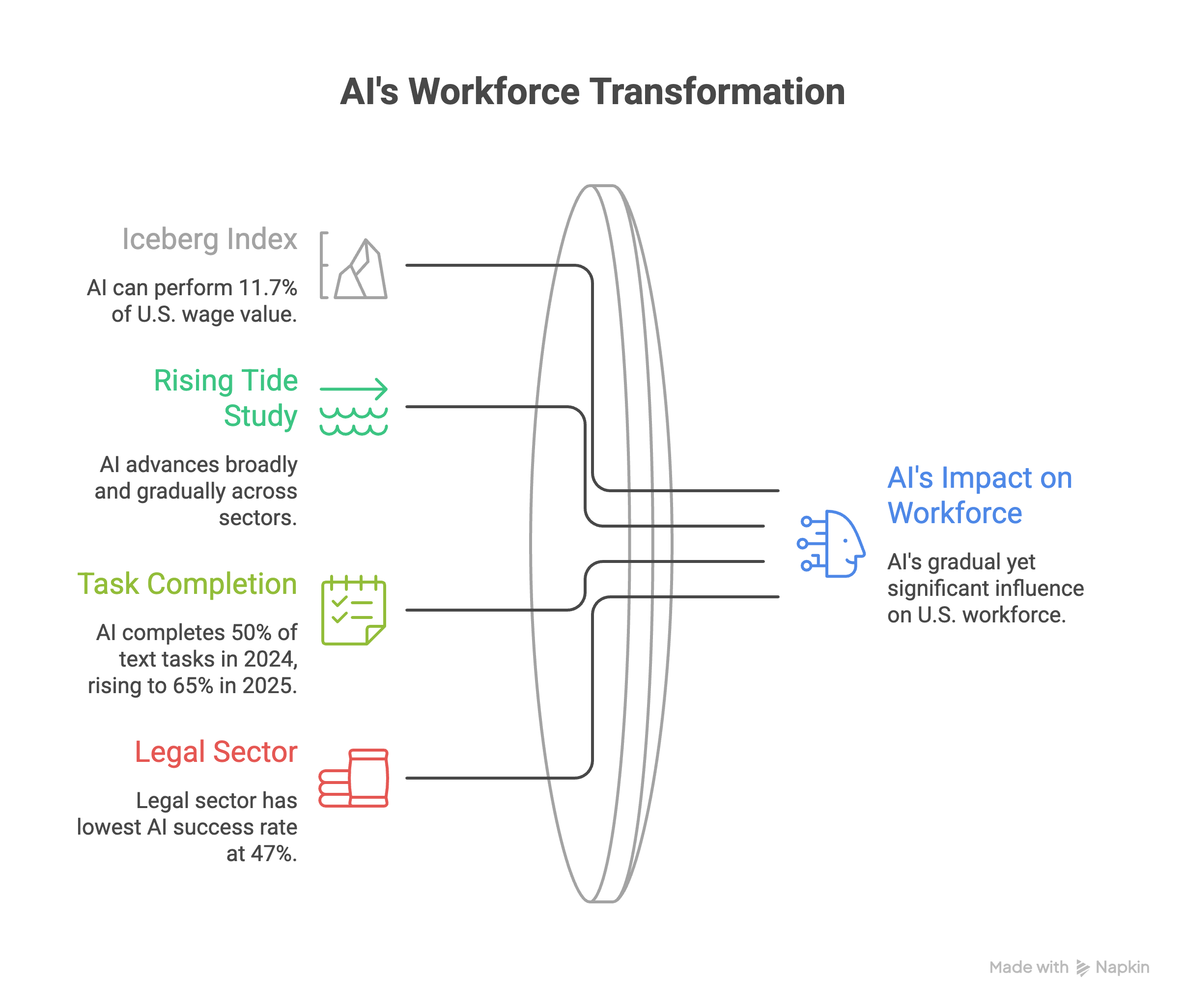
Two MIT studies provide important context on the pace and character of that disruption. The MIT/Oak Ridge National Laboratory Iceberg Index (Chopra et al., 2025) — a large-population simulation of 151 million U.S. workers interacting with 13,000 AI tools across 32,000 skills — found that AI can technically perform skills representing 11.7% of total U.S. wage value, or approximately $1.2 trillion annually, with exposure concentrated in administrative, financial, and professional services. A subsequent MIT study released in April 2026 reinforced a more measured picture, finding that AI advances across the workforce more like a “rising tide” than a “crashing wave” — broad and gradual rather than sudden (Axios, 2026). That study measured real-world task completion across 11,500 occupational tasks: in 2024, AI could complete roughly 50% of text-based tasks at a minimally acceptable level, rising to 65% by 2025, with a projected range of 80–95% by 2029 — but only at a “good enough” threshold, not at the reliability standard legal work demands. Critically, legal had the lowest AI success rate of any sector tested at just 47%, reflecting the precision, judgment, and strategic guidance the profession requires, compared to 73% in installation and maintenance and 55% in media and design (Axios, 2026).
A Harvard working paper tracking 62 million U.S. workers across 285,000 firms found that companies adopting generative AI saw junior employment drop roughly 9–10% relative to non-adopters within six quarters of adoption, while senior employment continued to rise — because the market is learning, in real time, that context is the scarce resource, not task execution (Hosseini Maasoum & Lichtinger, 2025).
The value of human workers increasingly lies not in performing discrete tasks that AI can handle — document drafting, basic research, form completion — but in the contextual judgment that determines whether those tasks are being done correctly for this client, in this matter, at this moment.
Evolving Role of Paralegals in the Age of AI
Rather than rendering paralegals obsolete, AI is poised to redefine the paralegal’s role. As automation takes over repetitive tasks, paralegals are expected to shift toward duties that require human expertise, oversight, and judgment. Paralegals will likely spend less time on initial document drafting and more time on reviewing AI-generated drafts for accuracy and nuance, ensuring that the output is legally sound and tailored to clients’ needs. In one sense, paralegals may become quality controllers for AI within law firms — an essential safety net to catch mistakes or “hallucinations” (false information) produced by AI tools.
Indeed, recent incidents underscore the need for human review. A well-publicized case in 2023 involved lawyers who submitted a brief with fake case citations fabricated by ChatGPT; the error was caught only when the cases could not be found, resulting in sanctions for the attorneys involved (Merken, 2023). The problem has only grown: DISCO’s 2026 AI & the Courts report documented over 1,000 court decisions referencing AI-related issues, a figure that has risen sharply year over year (DISCO, 2026). Sanctions are escalating as well — in March 2026, the Sixth Circuit imposed $30,000 in punitive fines in Whiting v. City of Athens after attorneys submitted briefs containing over 24 fabricated or misrepresented citations, with the court declaring it was sending “the loudest message” possible that such conduct would not be tolerated (Whiting v. City of Athens, 2026 WL 710568). Courts have also found that pro se litigants are not immune, with judges rejecting the argument that self-represented status excuses reliance on hallucinated AI output.
The hallucination risk documented in the research warrants precise characterization, because earlier framings were too narrow. Magesh et al. (2025) — now formally published in the Journal of Empirical Legal Studies — tested Lexis+ AI, Westlaw AI-Assisted Research, and Ask Practical Law AI on queries submitted during May 2024. Lexis+ AI correctly answered 65% of queries with a 17% hallucination rate; Westlaw AI-Assisted Research was accurate 42% of the time with a 33% hallucination rate. Critically, the study defined hallucination to include not only fabricated cases but also misgrounded citations — real cases cited for propositions they do not support, holdings reversed, overruled authority presented as good law, and litigants’ arguments attributed to the court. The authors explicitly note those subtler errors are more dangerous than outright fabrications precisely because they survive cursory review. Two caveats belong alongside those figures: the study tested May 2024 product versions that have since been updated with agentic architectures and additional verification layers, and the published error rates remain vendor-unverified. The verification responsibility belongs with the professional regardless of what current error rates happen to be.
Paralegals, with their research training and attention to detail, are well-suited to perform the verification role these cases demand. Going forward, a core responsibility for paralegals will be to act as a checkpoint: confirming the accuracy of AI-generated research, ensuring citations and facts are real, and generally safeguarding against errors that AI might introduce.
Apart from quality control, paralegals are expected to engage in more complex, analytical, and client-facing tasks as simpler tasks become automated. As Ghurbhurun (2024) suggests, the deployment of AI will shift paralegals’ focus to “nuanced, business-led advice rather than collation and administration of data,” with an emphasis on leveraging insights that AI might not catch and adding a human perspective. Paralegals could also take on more project management and coordination roles for complex litigation or transactions, managing workflows that include AI tools and human contributors. In effect, paralegals might become technology project managers in law firms, orchestrating the use of AI systems alongside traditional legal work.
Furthermore, paralegals will likely become key figures in maintaining ethical standards and client trust in an AI-enhanced practice. The ABA’s 2024 report on AI in the legal profession emphasizes the importance of using AI in a trustworthy and responsible manner, calling attention to issues like bias, privacy, and the limits of AI decision-making (ABA, 2024a).
Challenges and Ethical Considerations
Integrating AI into paralegal work comes with significant challenges and ethical considerations that require careful navigation. One major challenge is ensuring the accuracy and reliability of AI outputs. As noted, AI can sometimes produce incorrect or fabricated information with a confident tone, a phenomenon often referred to as AI “hallucination.” This is especially problematic in legal contexts, where decisions hinge on factual and legal accuracy.
As of early 2026, 47 state bar associations have issued some form of formal guidance on AI use in legal practice, up from six in mid-2023 (The Legal Prompts, 2026). ABA Formal Opinion 512 (July 2024) remains the governing national framework, addressing competence under Rule 1.1, confidentiality under Rule 1.6, client communication under Rule 1.4, and candor toward the tribunal under Rules 3.1 and 3.3 (ABA, 2024b). The California State Bar’s Committee on Professional Responsibility and Conduct (COPRAC) issued practical guidance in November 2023 on the responsible use of generative AI, emphasizing that existing ethical obligations apply to AI use, though it stopped short of mandating disclosure in all cases (State Bar of California, 2023). California’s COPRAC approved proposed rule amendments at its March 2026 meeting, weaving AI-specific language into six existing rules — including new commentary to Rule 3.3 specifically addressing hallucinations, and language to Rule 5.1 requiring firms to establish AI policies (The Law GPT, 2026). New York’s Unified Court System adopted 22 NYCRR Part 161, effective June 1, 2026, establishing disclosure and certification requirements for AI-generated filings (Promise Legal, 2026). More than 1,300 cases worldwide have now involved fabricated AI citations submitted to courts (The Law GPT, 2026).
Confidentiality and security present another layer of concern. Paralegals often handle sensitive client data, and if cloud-based AI tools are used, firms must ensure no confidential information is improperly disclosed to the AI service. The ABA’s 2024 Legal Technology Survey found that accuracy concerns (74.7%) and data privacy risks were among the top barriers to AI adoption in legal settings (ABA, 2024c).
Ethical use of AI also involves addressing bias and transparency. The Equal Employment Opportunity Commission settled its first AI-related hiring discrimination lawsuit in August 2023, involving a company whose hiring software automatically rejected older job applicants in violation of the Age Discrimination in Employment Act (EEOC, 2023). New York City’s Automated Employment Decision Tools Act similarly requires bias audits before employers can use automated decision tools. These developments highlight the broader concern about algorithmic bias that applies across legal AI applications.
For paralegals, the supervisory responsibility dimension is particularly direct. Rule 5.3 governs attorney supervision of non-lawyer staff; Opinion 512 extends that principle to AI output produced by or under the supervision of paralegal staff. A paralegal who uses an AI tool to draft a communication containing false information places the supervising attorney in disciplinary jeopardy. The responsibility does not originate with the paralegal — but the error does.
As guidance from ABA Formal Opinion 512 clarifies, candor toward the tribunal includes appropriate disclosure of AI use where relevant, and paralegals may play a role in documenting how AI was used in producing legal work, aiding attorneys in being forthright about their processes when required.
The Task-Versus-Job Gap: Why Employers Are Regretting AI-Driven Layoffs
While AI’s task-level capabilities continue to advance rapidly, a growing body of evidence suggests that organizations have overestimated AI’s ability to replace the full scope of human professional roles. This distinction between tasks and jobs has profound implications for paralegals, court personnel, and access-to-justice professionals.
Recent data paints a sobering picture for organizations that moved too quickly to replace human workers with AI. According to Forrester’s research, 55% of employers now regret AI-driven layoffs (Forrester Research, 2025). Gartner predicted in February 2026 that by 2027, half the companies that cut staff for AI will rehire workers to perform similar functions, often under different job titles. Their survey of over 300 customer service leaders found that only 20% had actually reduced headcount because of AI. One prominent example is Klarna, which cut roughly 700 customer service positions for an AI chatbot, only to reverse course and begin rehiring after discovering the AI could not handle the contextual complexity of real customer interactions at the quality their business required (Forrester Research, 2025).
The core issue is what researchers call the “task-versus-job gap.” AI benchmarks that provide models with all necessary context up front show impressive performance. But when agents are given real-world assignments that require them to bring their own context — understanding organizational history, informal relationships, unwritten norms, and institutional knowledge — performance drops dramatically. Scale AI and the Center for AI Safety tested frontier AI agents on 240 real freelance projects and found a 97.5% failure rate when agents had to operate with the kind of autonomy a real job requires (Mazeika et al., 2025).
This research carries a direct message for the legal profession. A paralegal who has spent years building relationships with court clerks, understanding a particular judge’s preferences, navigating the informal norms of local practice, and maintaining institutional memory about client matters holds exactly the kind of contextual knowledge that AI cannot replicate. Court personnel who understand the daily rhythms of their courthouse, the procedural quirks of their jurisdiction, and the needs of the self-represented litigants who appear before them carry irreplaceable institutional context. The Harvard working paper referenced earlier (Hosseini Maasoum & Lichtinger, 2025) found that companies adopting generative AI saw junior employment drop roughly 9–10% relative to non-adopters within six quarters of adoption, while senior employment continued to rise — because the market is learning, in real time, that context is the scarce resource, not task execution.
The lesson for legal professionals is clear: the value of human workers increasingly lies not in performing discrete tasks that AI can handle (document drafting, basic research, form completion) but in the contextual judgment that determines whether those tasks are being done correctly for this client, in this matter, at this moment. Paralegals, court staff, and access-to-justice professionals who can articulate and document that institutional knowledge will find their roles not diminished by AI, but elevated.
Building Core AI Competencies: The Six Essential Skills for Legal Professionals
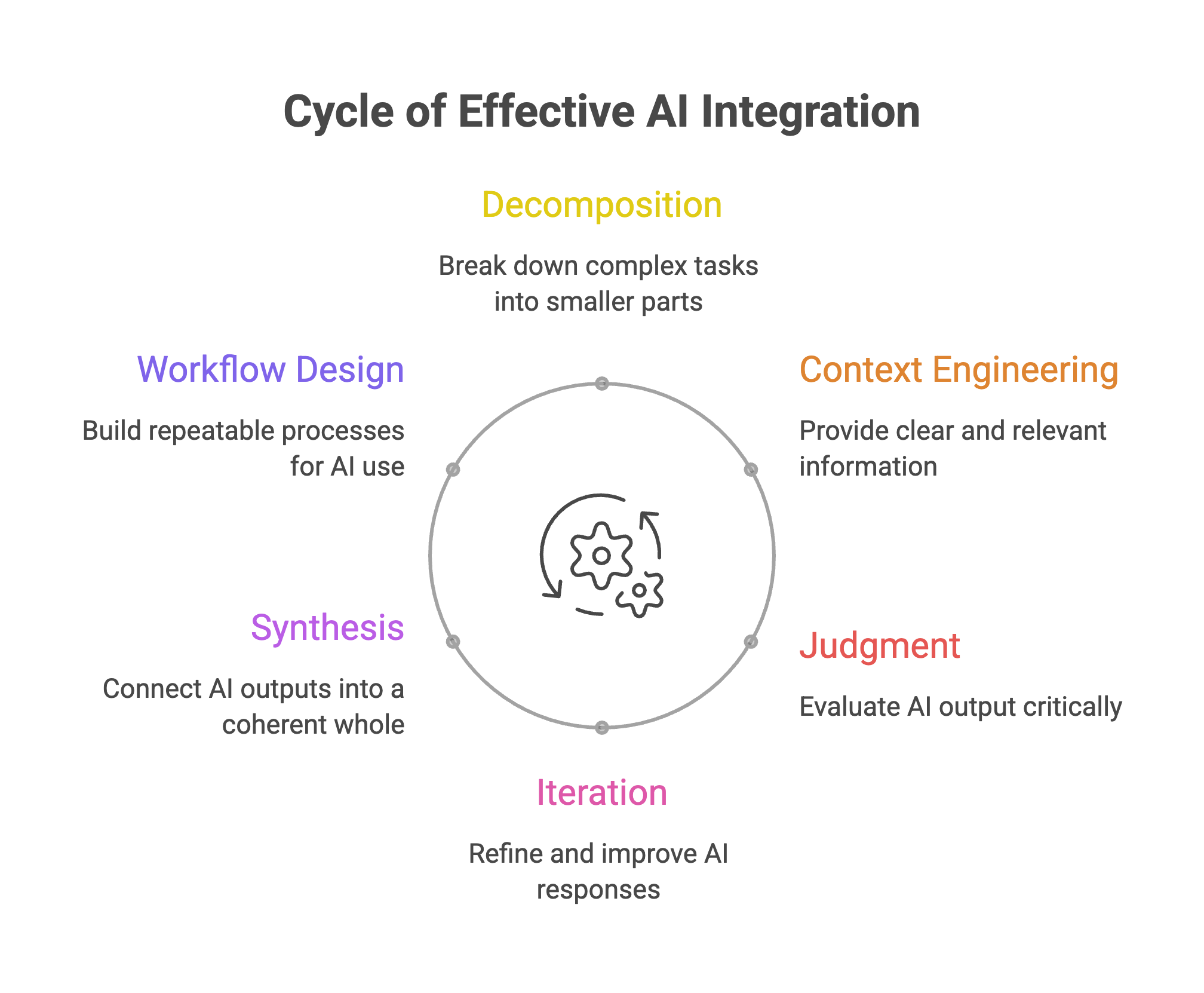
The gap between professionals who get consistent value from AI and those who abandon it after initial experimentation often comes down to a specific set of skills that go well beyond basic prompting. Research on AI adoption patterns within organizations identifies six core competencies that separate effective AI users from those who plateau at the novelty stage. These are not technical skills requiring coding knowledge; they build on the judgment, domain expertise, and organizational knowledge that experienced legal professionals already possess.
Decomposition — the ability to break complex assignments into smaller, sequenced components rather than handing AI a large, messy task and expecting a polished result in one pass. A paralegal preparing a motion for summary judgment, for example, should not ask AI to draft the entire motion at once. Instead, the effective approach is to separate the task: use AI to identify relevant case law, then analyze each case separately, then draft individual sections, then assemble and revise. This sequencing gives AI a better chance of succeeding at each step.
Context engineering — providing AI with the situational information it needs to produce useful output. AI works dramatically better when the objective is clear, the background is relevant, and constraints are explicit. For a paralegal, this means not simply asking AI to “research employment discrimination cases” but specifying the jurisdiction, the relevant statute, the key facts of the matter, the type of relief sought, and the standard the output needs to meet.
Judgment — knowing when an AI response is genuinely strong, when it is partial, and when it is confidently wrong. Legal work has the lowest AI success rate of any sector at 47% (Axios, 2026), and purpose-built legal research tools produce errors at rates that peer-reviewed research documents as substantial (Magesh et al., 2025). Maintaining independent evaluative judgment about AI output is the most legally consequential competency and the core professional obligation that AI has not displaced.
Iteration — treating AI interaction as a working session rather than a single query. The strongest AI users rarely accept the first response. They probe, tighten instructions, request alternatives, and test assumptions. A paralegal drafting a client communication might generate an initial version, refine the tone, verify the legal accuracy, then adapt it for the client’s level of sophistication. Each round of iteration typically produces meaningful quality improvement.
Synthesis — connecting AI outputs across a broader workflow rather than treating each interaction as an isolated event. In practice, this means using AI to identify themes across discovery documents, summarize deposition testimony, draft analytical frameworks, stress-test legal arguments, and then integrating those outputs into a coherent work product.
Workflow design — building repeatable processes that move AI use from isolated experimentation to dependable operational value. This means developing reusable prompt templates, quality control checklists, verification protocols, and clear handoff points between AI-generated and human-reviewed work. Without this discipline, adoption tends to plateau and organizations never move beyond the novelty stage.
These six competencies collectively represent what effective AI adoption looks like in practice. The Thomson Reuters Institute found that a majority of legal industry respondents expect agentic AI to be central to their workflow within three to five years (Thomson Reuters Institute, 2026); practitioners who develop these competencies now will be better positioned to govern those workflows when they arrive. Organizations that invest in developing these competencies across their staff will see dramatically better returns on their AI investments than those that simply provide tool access and hope people figure it out.
Expanding the Frame: Court Personnel and Access-to-Justice Professionals
While much of the discussion about AI in the legal profession has focused on law firms and their staff, the impact extends equally to court personnel and the growing category of access-to-justice professionals who serve as bridges between the legal system and the public. The access-to-justice gap — driven by high legal costs, geographical barriers, and a persistent shortage of legal aid resources — leaves vast numbers of Americans unable to afford or access the legal services they need. Studies consistently document that more than 80% of the civil legal needs of low-income Americans go unmet.
Across the United States, bar associations, state judiciaries, and access-to-justice commissions are taking on this challenge directly. Innovations in tiered legal services — models that expand who can provide legal help and how — are advancing in states from Utah to Arizona to California. States have created allied legal professional roles authorizing non-lawyer practitioners to provide limited legal services in housing, family law, and consumer debt. Technology is central to all of these models; for professionals entering these roles, AI competency is foundational, not supplemental.
Court personnel — clerks, court administrators, case managers, and judicial assistants — are encountering AI in their work in ways that mirror the paralegal experience but with distinct challenges. AI tools are increasingly being deployed for case management, document processing, scheduling optimization, and guided assistance for court users. Staff who develop AI competencies will be positioned to lead these implementations rather than be displaced by them.
The concept of “allied legal professionals” — non-lawyer practitioners authorized to provide limited legal services — represents an emerging tier of the profession where AI competency may be foundational from the start. For these professionals, AI will not be an add-on to learn later; it will be an integral part of their practice from day one. Court navigators helping self-represented litigants fill out forms, legal technicians advising on housing or family law matters, and community-based legal assistants could all leverage AI tools to extend their reach — but only if they develop the judgment to use those tools responsibly and the contextual knowledge to catch AI errors before they harm vulnerable clients.
The access-to-justice context sharpens the stakes of the verification responsibility considerably. A hallucinated procedural requirement given to a self-represented litigant through an AI-assisted court kiosk could result in a missed deadline, a default judgment, or the loss of housing — a far more direct and severe consequence than the same error in a corporate law firm memo.
Eviction defense and housing stability programs across the country offer compelling proof of concept. Access to counsel initiatives — in jurisdictions from New York City to San Francisco — have demonstrated that pairing trained legal professionals with technology-assisted intake and research tools produces measurable outcomes: cases resolved, evictions prevented, and families housed. Studies consistently show these programs generate $3 or more in economic benefit for every $1 invested. As these programs evolve, AI tools could amplify their impact — but only when guided by professionals who understand both the technology and the communities they serve.
Call to Action
Several practical strategies follow from the evidence reviewed in this article — not as aspirational recommendations, but as documented responses to documented conditions.
1. Embrace AI rather than resist it. Employers are pricing AI competency explicitly: PwC’s 2025 Global AI Jobs Barometer found that jobs requiring AI skills command a 56% wage premium over comparable roles without AI expertise, more than double the 25% premium documented just one year prior (PwC, 2025). The IAPP’s AI Governance Professional certification, launched in April 2024, correlates with 13% higher salaries for certified professionals (IAPP, 2024). The labor market has reached a verdict.
2. Develop deep domain expertise AI cannot replicate. A paralegal who combines subject-matter depth in intellectual property, litigation procedure, or real estate with effective AI tool usage produces insights that are both technically informed and contextually rich — a combination that a general AI model cannot match from either direction.
3. Build and document institutional knowledge deliberately. The task-versus-job gap research establishes that the scarce resource is contextual judgment: accumulated knowledge of clients, courts, procedures, and relationships. That knowledge becomes more valuable as AI absorbs discrete tasks, not less. Making it explicit — in process documentation, in template libraries, in annotated workflow guides — also protects it from loss when personnel turn over.
4. Master the six core AI competencies. Decomposition, context engineering, judgment, iteration, synthesis, and workflow design separate professionals who get consistent value from AI from those who plateau. These are learnable skills. Organizations that invest in them see materially better returns on AI investments than those that simply provide tool access.
5. Maintain a client-centered mindset. Clio’s 2024 Legal Trends Report found that 79% of legal professionals interacted with AI tools in 2024 — up from 19% the year before — yet client-facing roles remain essential for maintaining trust (Clio, 2024). Explaining how AI is used in a matter, ensuring clients feel heard, translating technical outputs into human understanding: these remain distinctly human contributions that automation has not touched.
6. Engage with the access-to-justice landscape. The expansion of tiered legal services and allied legal professional roles is creating new career pathways nationally for professionals who combine AI competency with a commitment to serving underserved communities.
Conclusion
AI’s impact on paralegals in the United States is profound and multifaceted. On one hand, AI offers powerful tools that can automate tedious tasks, enabling faster research, document processing, and insights — effectively boosting the productivity of paralegals and law firms. On the other hand, these same capabilities raise concerns about job security and the devaluation of skills that AI can emulate. The current evidence suggests that while many routine aspects of paralegal work will be automated, the profession itself is not on the verge of extinction. Instead, it is pivoting.
The net effect of AI on paralegals will likely be an augmentation of human capabilities rather than a wholesale replacement. Paralegals who adapt by mastering AI tools and focusing on higher-order skills are poised to thrive; they will be able to handle larger workloads and more complex projects by leveraging AI as a force-multiplier. Those unwilling to adapt, however, may find the traditional aspects of their job shrinking. Thus, the coming years represent a pivotal period of professional evolution. Educational institutions, professional associations, and law firms all have a role to play in supporting paralegals through this transition — be it via training, setting ethical guidelines, or redesigning workflows to integrate AI in a balanced way (ABA, 2024b).
AI’s impact on paralegal work is not a story about replacement. It is a story about what gets automated and what gets elevated — and the two categories follow the line between task execution and contextual judgment. The human element in law — empathy, judgment, creativity — will remain in demand, and with AI as an ally, paralegals can deliver even more value in these areas. That line has always been where the most capable practitioners have positioned themselves.
Dr. Donald G. Billings · A Unique Blend of Technical Expertise, Legal Insight, & Business Acumen · Original Content · Revised and Fact-Checked August 2026
References
8am.com. (2026). 2026 legal industry report: AI adoption surges through turbulence as firms push forward. 8am.com. https://www.8am.com/blog/ai-adoption-law-firms-2026-legal-industry-report/
American Bar Association. (2024a). Year I report on the impact of AI on the practice of law. ABA Task Force on Law and Artificial Intelligence. https://www.americanbar.org/news/abanews/aba-news-archives/2024/08/aba-task-force-report-ai-opportunities-challenges/
American Bar Association. (2024b). Formal Opinion 512: Generative artificial intelligence tools. ABA Standing Committee on Ethics and Professional Responsibility. https://www.americanbar.org/content/dam/aba/administrative/professional_responsibility/ethics-opinions/aba-formal-opinion-512.pdf
American Bar Association. (2024c). 2024 legal technology survey report. ABA Legal Technology Resource Center. https://www.americanbar.org/groups/law_practice/resources/legal-technology-resource-center/tech-survey/ (report available for purchase at shopaba.org)
American Bar Association. (2025, December 15). Addressing the legal challenges of AI: Year 2 report on the impact of AI on the practice of law. ABA Task Force on Law and Artificial Intelligence. https://www.americanbar.org/content/dam/aba/administrative/center-for-innovation/ai-task-force/2025-ai-task-force-year2-report.pdf
Artificial Lawyer. (2025, September 22). Legal education must change because of AI — survey. Artificial Lawyer. https://www.artificiallawyer.com/2025/09/22/legal-education-must-change-because-of-ai-survey/
Axios. (2026, April 2). MIT study challenges AI job apocalypse narrative. Axios. https://www.axios.com/2026/04/02/ai-jobs-mit-study-workforce-impact
Briggs, J., & Kodnani, D. (2023, March 26). The potentially large effects of artificial intelligence on economic growth. Goldman Sachs Global Investment Research. https://www.gspublishing.com/content/research/en/reports/2023/03/27/d64e052b-0f6e-45d7-967b-d7be35fabd16.html
Bureau of Labor Statistics. (2024). Paralegals and legal assistants. Occupational Outlook Handbook, U.S. Department of Labor. https://www.bls.gov/ooh/legal/paralegals-and-legal-assistants.htm
Case Western Reserve University School of Law. (2025, January 21). CWRU School of Law becomes first law school in the U.S. to require legal AI education certification for all first-year law students. CWRU Newsroom. https://case.edu/news/case-western-reserve-school-law-becomes-first-law-school-us-require-legal-ai-education-certification-all-first-year-law-students
Chopra, A., Bhattacharya, S., Salvador, D., Paul, A., Wright, T., Garg, A., Ahmad, F., Schwarze, A. C., Raskar, R., & Balaprakash, P. (2025). The Iceberg Index: Measuring skills-centered exposure in the AI economy. MIT & Oak Ridge National Laboratory. arXiv:2510.25137. https://iceberg.mit.edu/report.pdf
Clio. (2024). 2024 legal trends report. https://www.clio.com/resources/legal-trends/2024-report/
ComplexDiscovery Staff. (2024, November 12). Generative AI adoption in legal sector expected to surge, new study finds. ComplexDiscovery. https://complexdiscovery.com/generative-ai-adoption-in-legal-sector-expected-to-surge-new-study-finds/
DISCO. (2026). AI & the courts: 2026 report. DISCO.
Equal Employment Opportunity Commission. (2023). iTutorGroup to pay $365,000 to settle EEOC discriminatory hiring suit. EEOC Press Release. https://www.eeoc.gov/newsroom/itutorgroup-pay-365000-settle-eeoc-discriminatory-hiring-suit
Forrester Research. (2025). Predictions 2026: The future of work. Forrester. https://www.forrester.com/report/predictions-2026-the-future-of-work/RES185020
GC AI. (2026). Best legal AI tools in 2026: 14 platforms reviewed for lawyers. GC AI. https://gc.ai/blog/legal-ai-tools
Ghurbhurun, R. (2024, October 14). The impact of AI on paralegals — preparing for the future. Legal IT Insider. https://legaltechnology.com/2024/10/14/guest-post-the-impact-of-ai-on-paralegals-preparing-for-the-future/
Hosseini Maasoum, S. M., & Lichtinger, G. (2025, August 31). Generative AI as seniority-biased technological change: Evidence from U.S. résumé and job posting data. SSRN Working Paper. https://papers.ssrn.com/sol3/papers.cfm?abstract_id=5425555
International Association of Privacy Professionals. (2024). AIGP: Artificial intelligence governance professional certification. IAPP. https://iapp.org/certify/aigp
International Legal Technology Association. (2024). ILTA’s 2024 technology survey. ILTA Publications. https://www.iltanet.org/resources/publications/surveys/ts24
JD Journal. (2026, July 2). US law firms see legal job growth in June. JD Journal. https://www.jdjournal.com/2026/07/02/us-law-firms-see-legal-job-growth-in-june/
Knutsen, T. (2024). Why AI is bad for paralegals. AI Consequences. https://aiconsequences.com/why-ai-is-bad-for-paralegals/
The Law GPT. (2026, June 6). Legal AI ethics 2026: ABA Opinion 512 & confidentiality. The Law GPT. https://www.thelawgpt.com/blog/legal-ai-ethics-aba-opinion-512-2026
Magesh, V., Surani, F., Dahl, M., Suzgun, M., Manning, C. D., & Ho, D. E. (2025). Hallucination-free? Assessing the reliability of leading AI legal research tools. Journal of Empirical Legal Studies, 22, 216–248. https://doi.org/10.1111/jels.12401
Mazeika, M., Gatti, A., Menghini, C., Sehwag, U. M., Singhal, S., Orlovskiy, Y., et al. (2025). Remote labor index: Measuring AI automation of remote work. arXiv:2510.26787. Center for AI Safety & Scale AI. https://arxiv.org/abs/2510.26787
McKinsey & Company. (2022, December 6). The state of AI in 2022 — and a half decade in review. McKinsey Global Survey on AI. https://www.mckinsey.com/capabilities/quantumblack/our-insights/the-state-of-ai-in-2022-and-a-half-decade-in-review
Merken, S. (2023, June 26). New York lawyers sanctioned for using fake ChatGPT cases in legal brief. Reuters. https://www.reuters.com/legal/new-york-lawyers-sanctioned-using-fake-chatgpt-cases-legal-brief-2023-06-22/
PlatinumIDS. (2026, April 2). The rise of agentic AI in legal technology: From assistants to autonomous workflows. PlatinumIDS Blog. https://blog.platinumids.com/blog/agentic-ai-legal-technology
Promise Legal. (2026). AI ethics compliance for law firms: ABA Opinion 512. Promise Legal. https://blog.promise.legal/ai-ethics-compliance-law-firms-2026/
PwC. (2025). The fearless future: Global AI jobs barometer 2025. PricewaterhouseCoopers. https://www.pwc.com/gx/en/issues/artificial-intelligence/job-barometer/2025/report.pdf
Robert Half. (2026). 2026 legal job market: In-demand roles and hiring trends. Robert Half International. https://www.roberthalf.com/us/en/insights/research/data-reveals-which-legal-roles-are-in-highest-demand
Roth Staffing. (2026, March 19). Legal hiring trends to watch in Q2 2026. Roth Staffing. https://www.rothstaffing.com/legal-hiring-trends-q2-2026/
State Bar of California. (2023). Practical guidance on the responsible use of generative AI in the practice of law. COPRAC. https://www.calbar.ca.gov/sites/default/files/portals/0/documents/ethics/Generative-AI-Practical-Guidance.pdf
Susskind, R., & Susskind, D. (2022). The future of the professions: How technology will transform the work of human experts (Updated ed.). Oxford University Press. https://global.oup.com/academic/product/the-future-of-the-professions-9780198841890
The Legal Prompts. (2026). AI legal ethics for lawyers: Bar association rules & guidelines (2026). The Legal Prompts. https://thelegalprompts.com/blog/ai-legal-ethics-bar-association-guidelines
Thomson Reuters. (2023, October 2). Will AI replace paralegals? Let’s separate fact from fiction. Thomson Reuters Legal Blog. https://legal.thomsonreuters.com/blog/will-ai-replace-paralegals/
Thomson Reuters. (2026, February 24). One million professionals turn to CoCounsel as Thomson Reuters scales AI for regulated industries [Press release]. PR Newswire. https://www.prnewswire.com/news-releases/one-million-professionals-turn-to-cocounsel-as-thomson-reuters-scales-ai-for-regulated-industries-302694903.html
Thomson Reuters Institute. (2026). 2026 AI in professional services report. Thomson Reuters Institute. https://www.thomsonreuters.com/en-us/posts/technology/agentic-ai-oversight-challenges/
Whiting v. City of Athens, Tenn., Nos. 24-5918/5919, 25-5424, 2026 WL 710568 (6th Cir. 2026).
Wolters Kluwer. (2024). Future ready lawyer survey 2024. Wolters Kluwer Legal & Regulatory. https://www.wolterskluwer.com/en/know/future-ready-lawyer-2024
World Economic Forum. (2025, January). The future of jobs report 2025. World Economic Forum. https://reports.weforum.org/docs/WEF_Future_of_Jobs_Report_2025.pdf